

Our Process
Let’s Work Together.
For a new client, it can be unnerving to invest a lot of money on a project that has never been done before. We like to begin the relationship by educating the client regarding our approach, and thereby begin to earn their trust.
This begins with an introduction to the Project Manager (PM), who will be the point person and advocate for the client once the project is in production. The PM serves as the information conduit between the customer and Dillon Works. It is their job to always be several steps ahead in the process and make every effort to keep the client informed, as well as uphold the integrity of the design and vision.
“It takes us educating the client and earning their trust.”

Design
It’s the job of our designers (working in concert with our Project Managers), to prove to you why we do what we do. Using the tools at our disposal (Rhino, Sketchup, Adobe Creative Cloud, AutoCAD, etc. and sometimes even a pencil), we will do just that.
When a potential client comes to us for the first time, it is a bit disconcerting for them to spend a lot of money on a project that likely has never been done before. It’s not like buying a bag of onions at the grocery store. It takes us educating the client and earning their trust. This is where design plays a crucial role.
Why did we use plastic instead of wood?
Why did we galvanize the steel first?
Why shouldn’t there be a slide right next to the monkey bars?
Why are there only chocolate donuts?
For every action we take in design, there is a reason for it, often based on experience. It is our job to educate you as to the decisions we make, and why they are good for your project. After we do that, little by little, we start to earn your trust.
Our ultimate goal is to earn your trust.
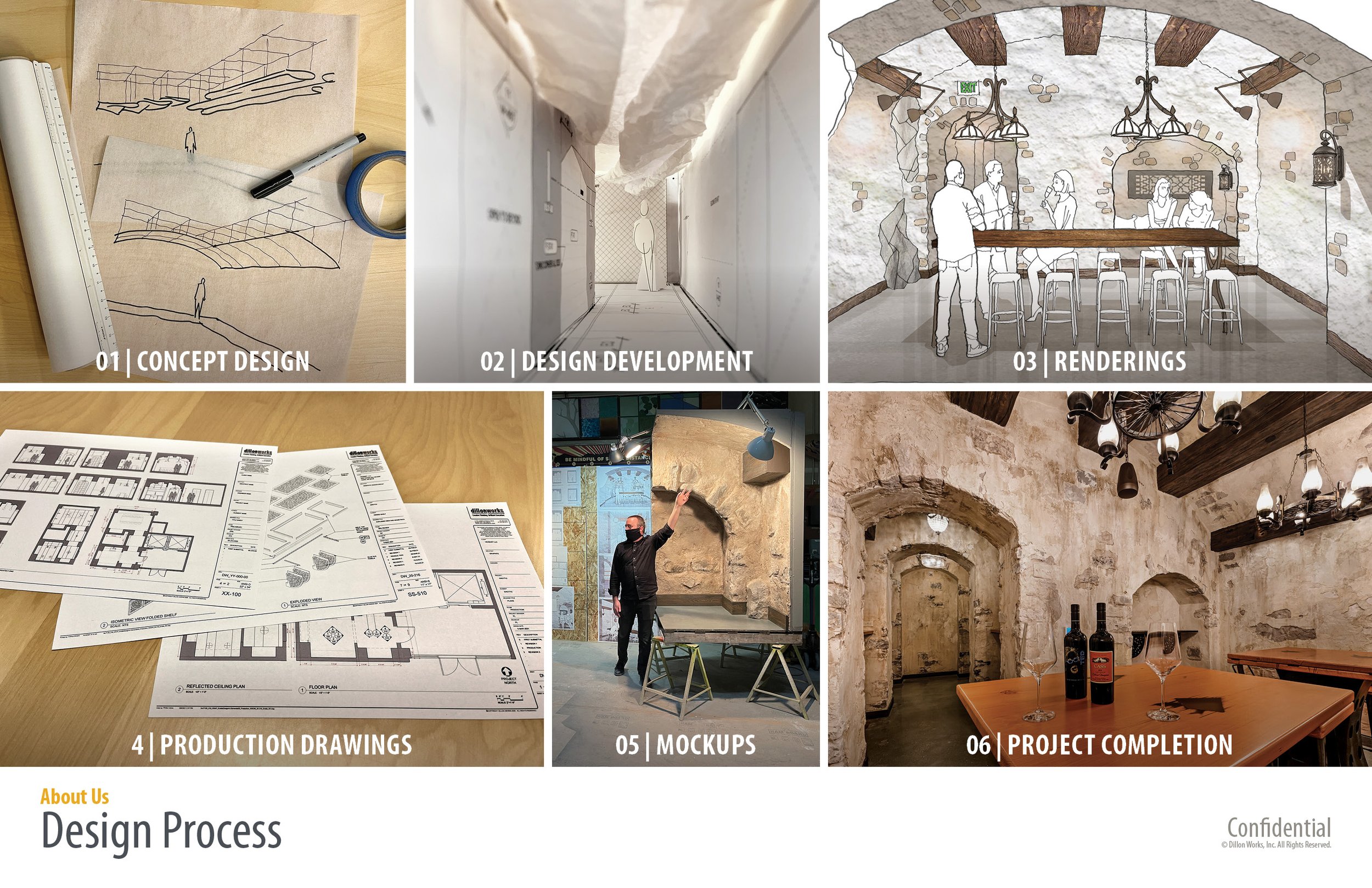
A conversation becomes a sketch…becomes a digital model…becomes a package of shop drawings…becomes an amazing project that will knock your socks off.
So, once we earn your trust…well…that’s a mighty fine bag of onions.
-
A concept starts as an idea…
Ideas don’t grow on trees! They’re like delicate little baby birds that you need to hold gently in your cupped hands and sing to, and nurture until they gain strength and take flight. We’ll help you feed your little baby bird of an idea. We’ve got worms!
When it comes to designing a project, there are several ways we can collaborate. You can provide us with finished blueprints, rough sketches, a vague gesture or simply a thought and we can work with you from there.
Ideally, we like to get involved early so we can help tailor the design and fabrication to your budget, ensuring the maximum impact for your money.
After all, we understand how wide – ranging costs can be. Either way, our staff designers are here to help make ideas, at any stage of development, into reality. -
Design Development is when we “flesh out” the design…
We pick colors, choose finishes and finalize the look and feel. It’s like taking a blurry picture and snapping it into focus. The clouds part and white doves fly out of the rendering and then everyone just stands in wonderment with their jaws dropped.
Well, that’s what we strive for, but don’t expect it to happen every time. -
A vast majority of our projects require some sort of engineering. It might be structural, mechanical or electrical. They calculate worst case scenarios for each element where structural integrity of the element or scope impacts safety, functionality and reliability.
They ask themselves important questions such as –
“Can it stand up?”
“Will it still be standing after a windstorm or earthquake?”
“Are you guys crazy?”
Do you REALLY expect me to stamp these drawings?
Once they are satisfied that they have all the answers, they will stamp the drawings to certify that the design meets the codes and regulations for the area in which it will be installed. -
On occasion, scale models are created to help a client better understand the way a single element will function within a space.
This might mean an image rendered in the latest 3D modeling software or a hand-sculpted clay model that can be scanned via computer and used to produce a full-scale version.
We work with you, from the onset, to customize the design process to do what is most appropriate and effective for your project. -
Both our 3-D printers and CNC routers allow us to test concepts and designs in real space then refine and perfect those designs before the first production parts are even ordered. This is just one more way that technological advances in manufacturing have helped us to become faster and more efficient in what we do.
-
A shop drawing is a drawing or set of drawings produced to explain the details of fabrication and/or installation of the elements to our folks who are building our projects. Dimensions, manufacturing conventions, and special fabrication instructions are included on the shop drawings. It should be clear to fabrication personnel what will be manufactured from the shop drawings alone.
They are the nuts and bolts of how it works.
The client then has the opportunity to review these drawings prior to fabrication to make sure we’re creating something that will knock their socks off…
“We know that clean and concise communication, both internally and with our clients, is at the heart of a well-run project.”
Project Management
Our Project Managers (PMs) are considered the “point” people and client advocate once the project is in production. They serve as the information conduit between the client and Dillon Works, as well as all departments within the company. They strive to be several steps ahead in the process, anticipating material, information, and critical milestone and deadline requirements.
The PM makes every effort to keep our clients informed as to the progress of their project and uphold the integrity of the client’s design concepts and vision. Constant contact is encouraged via telephone, fax, and e-mail, along with electronic images and onsite inspections to track progress. Finish samples are routinely submitted to help insure we are meeting the expectations of our clients. In addition to our weekly production meetings, ad hoc meetings are held throughout the course of the project to resolve issues and keep staff current on immediate problem-solving discussions.
We know that clean and concise communication, both internally and with our clients, is at the heart of a well-run project. It is always our goal to establish a well-articulated scope of work up-front to minimize misunderstandings later in the project lifecycle. When problems do crop up (and let’s face it, they do!) our objective is to work proactively with our clients to resolve the issue with minimal disruptions to both the contracted scope of work, budget and ultimately the schedule.
-
Critical to the success of any project is a clear understanding of the aesthetic and contractual parameters. At the core of this understanding is defining the management criterion; budget, schedule and scope.
Our projects typically take one of two forms; build to scope projects and design-build projects. Build to scope traditionally means our client has a clear understanding of what they want us to do and we’re either provided with a budget or asked to competitively bid their work.
Design-Build projects frequently involve developing a design to a budget target provided to us. This scenario allows much more flexibility with the design and allows our client to participate in the development of the idea to specifically suit their needs.
In either case, once the design is advanced to the point it can be defined, a detailed budget, tied to a defined scope of work is the heart of the agreement and forms the basis of the contractual relationship. To the degree that we can accurately describe the budget and scope, we can avoid misunderstandings as the project develops -
Scheduling involves defining tasks, their duration, and their relationship to other tasks that lead to a completed job. At Dillon Works we start by understanding our client’s significant milestones and deliverable dates first, we then develop an internal design and production schedule that identifies critical dates, long lead items, outside resources, etc. and further defines the plan to meet those goals.
Our experience tells us that scheduling should be done with contingency planning and running what-if scenarios to ensure that any disruptions to the schedule can be met with a solid work-around plan. We also include client approvals in our planning to allow sufficient time for our clients to review their work, make comments and generally be a contributing member of the team.
As we are typically producing multiple projects simultaneously, it is important to overall company planning that an all-Dillon Works design and production schedule is developed and maintained. This master schedule sets the plan to orchestrate and coordinate the many multi-disciplinary tasks of the internal and external resources needed to accomplish project and company goals. -
Coordinating the various internal and external project activities and related trades is a common practice for the Project Managers at Dillon Works. We do this as a service to our client, but also to ensure that the project moves forward to a successful completion with a minimum of disruptions.
At Dillon Works we recognize that some of the project activities are often best performed by outside tradesmen and specialists.
We also recognize that external resources can often be a source of problems without a strong quarterback, or project manager, coordinating the many integrated activities.
Let’s just say that in order to be a great Project Manager, you need to be very coordinated.
“Production is a complicated dance for which the music is a little different every time.”

Production
More specifically, it’s a collaborative exercise between the Production Manager, the APM (Accounts Project Manager) and the individual shop Supervisors that involves the coordination of materials, schedules and the specific needs of the different departments here at Dillon Works. Working hand in hand, each helps the other to smoothly and efficiently shepherd a job through the build process.
It begins when a packet of drawings has been completed in design. These drawings are then distributed to each of the shop supervisors for a final review. This stage of the process, called “red lines,” allows all parties to voice any last concerns about the approach or sequencing of the build. The drawings then go back to the designer where any revisions that need to be made are incorporated into an updated set of drawings and sent to the client for final approval.
-
Concurrent to this process is the ordering of all the raw materials needed by each department. This is done by the various department heads while any specialty items, like monitors, props, lighting components or materials with longer lead times, are the responsibility of the APM. “Cut files,” which refer to the information created during the design phase that an outside vendor will use to provide any additional building components, have also been sent out. All this must be carefully timed so that materials are ready and available as soon as the green light has been given to proceed. When this is done to everyone’s satisfaction, the build can begin.
Throughout the entire fabrication process, a continuous dialogue goes on between the production manager, the Project Manager and the Department Heads. Completion milestones are built into the schedule and checked off as the job progresses. This tracking allows the project managers to keep the client well informed about the progress of the job while also allowing for feedback and review. -
As our work is normally quite specialized, and normally constrained by tight schedules and time critical deadlines, we take great care in planning of packing and shipping our projects. We explore many options before determining the best approach to the transportation of sometimes fragile pieces to insure on time deliveries and the minimum possibility of damage.
Trust us; you’ll sleep well at night.
Our shipping experience includes diverse themed elements developed, packaged and shipped to many domestic and international destinations and we maintain a network of forwarders and other specialists to assist in that effort. -
Everything that we make in the shop and ship across the country, or even just down the block, must be built in sections and reassembled somewhere else.
Once on site, a finished, painted component, regardless of how big and unwieldy it is, still needs to be put in place. That means getting it moved, bolted to the floor (or hung from the ceiling) and then trimmed out so that no seams or gaps are visible. It means the lights must work and the “turn-y thing” must turn.
This is where our amazing installation team comes in.
Whether they are on the other side of the globe speaking through an interpreter to supervise a crew of local workers, or marshalling our own troops closer to home, our install professionals must be calm, creative problem solvers who work well under pressure and always present a smile to our clients. Because despite the best efforts of everyone involved, it is rarely the case on a job site that some unforeseen obstacle has not been placed in the way. It might be a lack of access to the space, or a door that is smaller than the objects that have to go through it, or a marble floor that has been installed earlier than planned and makes the use of a forklift impossible. Whatever the case, the show must go on and the installer must figure out how to make it so.